American Airlines is reportedly preparing to launch a new performance-tracking initiative titled the “Me@Work” program. Under this system, flight attendants will be evaluated and assigned scores based on a variety of metrics collected over a rolling 12-month period.
While the move aims to introduce greater accountability into cabin service, the implementation faces significant hurdles regarding data accuracy and labor relations.
How the Scoring System Works
According to recent reports, the Me@Work program will utilize several data points to determine an individual crew member’s score. While the full scope of the program remains under wraps, the primary metrics are expected to include:
- Customer Experience: Based on anonymized Net Promoter Score (NPS) surveys sent to passengers following their flights.
- Operational Contributions: A metric that currently lacks specific definition but likely pertains to efficiency and protocol adherence.
- Flight Delays: Delays that are officially coded as being caused by flight attendant performance or actions.
The Challenges of “Subjective” Metrics
The introduction of performance-based scoring in the airline industry is a complex issue. While many industry analysts have long noted that U.S. airlines lack a robust system for evaluating onboard staff—often leading to inconsistent service quality—the specific metrics chosen by American Airlines raise several logical concerns:
1. The Reliability of Passenger Surveys
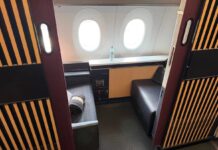
Passenger perception is highly subjective and can be influenced by factors entirely outside a flight attendant’s control. For example, a crew member flying long-haul international routes in premium cabins on a Boeing 787-9 may receive vastly different feedback than a crew member operating short-haul domestic flights on a Boeing 737. The “experience” of the passenger is often tied to the aircraft type, seat comfort, and route, rather than just the service provided.
2. Attribution of Delays
Attributing flight delays to specific crew members is a contentious process. In the complex ecosystem of aviation, delays are frequently the result of interconnected issues involving ground handling, air traffic control, or mechanical problems. Determining exactly when a delay is “the fault” of a flight attendant remains a significant operational challenge.
A Climate of Friction
The timing of this rollout is particularly sensitive. The relationship between American Airlines management and its workforce is currently strained. The Association of Professional Flight Attendants (APFA), the union representing the airline’s cabin crew, has historically been a vocal critic of management decisions.
This tension is underscored by a recent vote of no confidence issued by flight attendants against CEO Robert Isom. Introducing a high-stakes scoring system during a period of low institutional trust is likely to trigger significant pushback from labor representatives, who may argue that the system is unfair or lacks transparency.
The central question remains: Will this program serve as a constructive tool for professional development, or will it become a source of friction that further damages the relationship between the airline and its employees?
Conclusion
American Airlines is attempting to solve the industry-wide problem of inconsistent service through data-driven accountability. However, unless the airline can ensure that its metrics are truly reflective of individual performance, the Me@Work program risks becoming a controversial tool that fuels labor unrest rather than improving the passenger experience.