Go to Newfoundland. Find the Great Northern Peninsula. Walk to Flower’s Cove. It is a tiny place, quiet, and completely unique.
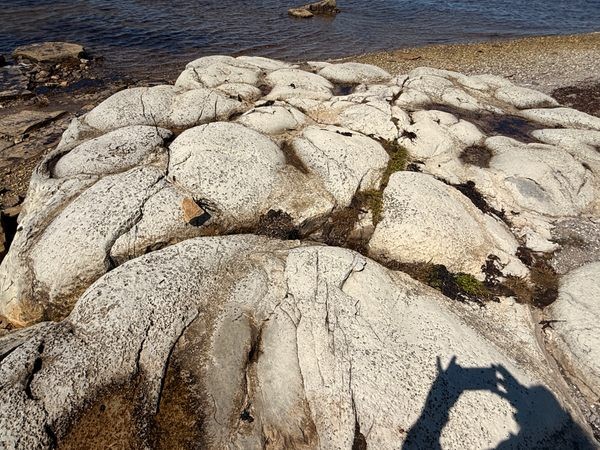
You won’t find this elsewhere. There is another spot somewhere, maybe two, but here? The shoreline holds fossils of some of Earth’s most primitive life. They are thrombolites. Gray buns of rock. Six hundred fifty million years old. That number wraps your head around it, or doesn’t, but the age is undeniable. The name means “clotted structure.” Simple enough.
They are thought to be the first creatures on the planet to release free oxygen.
Before that air? Suffocating. After them? Breathable. They beat dinosaurs by two hundred twenty-five million years. Let that sit for a moment. No T-Rex, no Jurassic Park. Just these clots.
Not Just Rocks
They aren’t small. Three or four meters across, these things.
Some are broken, shattered by time or tide. Most keep their shape: a circular center surrounded by wedges like pie slices. People call them “living rocks.” A bit dramatic? Perhaps. But they were made by single-celled microorganisms, ancient ones, pulling calcium carbonate from the water to build these layers. Slow work. Solid gray results that look like flattened boulders left by a giant’s grocery trip.
Look closer.
Darker rocks sit nearby. Glacial erratics. Rounder. Older in a different way? Deposited by the Pleistocene glaciers, they intersperse with the thrombolites, confusing the eye a little. Which is which?
The Skin of the Ancient
Touch them. Well, maybe look first. The surfaces hold faint, irregular prints. Lichens cling in random spots, adding a touch of life to the ancient. The furrows? Could be drainage channels from the ebb and flow of the tide. Cracks. Wear and tear from centuries of salt.
The bigger ones? Maybe not one creature but several communities stuck together, amalgamated over eons. And the younger specimens? Burrows. Tunnels made by metazoan organisms from prehistory. Little diggers, gone long ago, but their tunnels remain. Who did you think you were sharing this beach with?
Getting There
Cross Marjorie’s Bridge. It is wooden. Painted red and white. Picturesque. A boardwalk leads you across. Then the short trail begins.
The thrombolites wait.
To the south, across the bay, there are more. Another large collection hiding on the other side. You see what you see, but the rest waits in the water, silent and gray, breathing in the air they created.