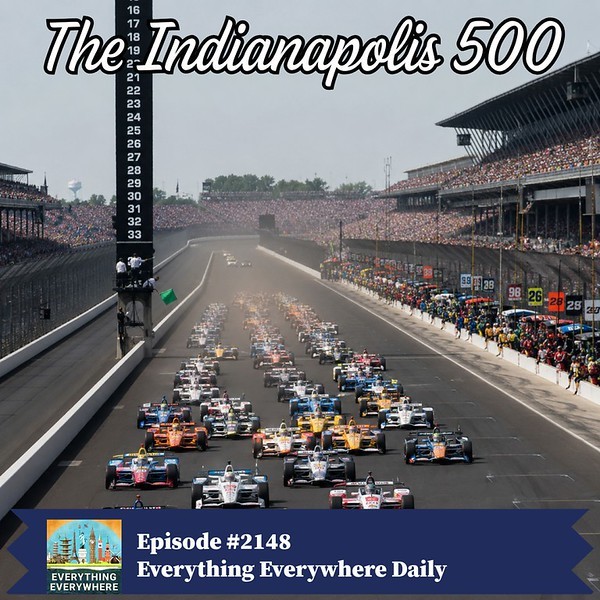
The track hums. Thirty-three cars scream down the straightaway at speeds that would terrify the people who originally paved it. It started as a test for machines. Now it’s a Memorial Day ritual at the world’s biggest motorspeedway.
The Brickyard Origin
To get the 500 right, you have to start with the pavement. In 1909, Indianapolis was an auto hub. Entrepreneur Carl Fisher wanted a place to test cars at actual speed, not just on dirt roads. He and three partners built a 2.5-mile on an oval plot of farmland outside the city. This place is now its own town, Speedway, Indiana.
The early races were ugly. Dangerous. The surface was crushed stone mixed with tar. Five drivers died during the second race weekend alone.
Fisher reacted by buying bricks. Three and a half million of them. This gave the track the nickname that still sticks, the Brickyard.
After two years of multiple meets, they streamlined it. Starting in 1911, just one big event per year. 500 miles. On May 30 of that first year, 40 cars showed up for an crowd of 80,00 people. Ray Harroun drove the Marmon Wasp to victory. His time? Six hours and forty-two minutes. It’s still the slowest winning time ever recorded.
But Harroun didn’t just drive well. He invented things. No passenger meant no one to signal back. So he mounted a mirror on his steering wheel. The first rear-view mirror in history. He also gave the car a tail to stabilize airflow. Early aerodynamics.
European manufacturers saw the opportunity. Fiat. Mercedes. Peugeot. French drivers Jules Goux (1913) and René Thomas (1914) took the title. It wasn’t just a race. It was a laboratory for tires, fuels, and brakes. By WWI, the Indy 50 was already America’s biggest motor event.
Asphalt and Silver
The bricks couldn’t handle the speed increase. Starting in the 193, turns were covered in asphalt. All four were done by 1937. The front stretch bricks lasted longer. In 1961 the final sections went under tar. Only one thing remains untouched: a three-foot strip of red clay bricks at the start line. The Yard of Bricks.
Then there’s the trophy. Commissioned by Borg-Warner in 193. Designed by Robert Hill, forged in sterling silver by Gorham Inc. Louis Meyer won the first one in 193 after his third win. It’s nearly five feet tall. It features a sculpted face for every single winner in history. The original sits in the museum. Since 198, winners take home a replica, affectionately called the “Baby Borg.”
That same year, Meyer stood in Victory Lane. Someone handed him milk. He drank it. It looked cool on film. A tradition was born, though it faded post-WWII until dairy groups revived it as a formal ritual in 195. Today drivers choose their milk type in advance. Usually white. Sometimes chocolate.
War and Rescue
Fire killed half of Gasoline Alley the garage area in 194. The 1942 race was canceled. Then came WWI, which also shut things down. The war resumed in 194 but stopped again for 194-4.
When the shooting finally stopped, the Speedway was crumbling. Developers wanted to tear it up for houses. Wilbur Shaw, a three-time winner, looked for a buyer who cared about the sport. He found Tony Hulman, a businessman from Indiana. Hulman bought the place in 194.
This rescue saved the race. Hulman fixed the grounds. He boosted the prestige. He cemented the Memorial Day link that defines the holiday now.
Engines and Icons
The 50s belonged to the “roadsters.” Front-engine cars. Powered largely by the Offenhauser engine. It won 2 times total more than any other engine. Kurtis Kraft chassis dominated 5 years straight, from 9 to 55. Drivers like Bill Vukovich became legends.
The 60s brought shockwaves. The “British invasion.” Jim Clark arrived with his Lotus-Ford. He moved the engine from the front of the car to the back. It changed the physics of racing entirely. Lower profiles. Better balance. Real aerodynamics.
Formula One stars started coming to Indiana. Clark, Jackie Stewart, Graham Hill. They treated the oval like a race track. It worked.
The Golden Age
The 70s and 8os? That’s when it felt big. TV coverage expanded. American heroes dominated.
A.J. Foyt won four times. Al Unser did the same, adding his 8 win just days before turning 4. Rick Mears defined the 80s, winning four times and hitting an average speed of .1 mph in 4.
The closest finish ever happened in . Al Unser Jr. edged out Scott Goodyear. The gap? Less than a tenth of a second.
The Split
Everything unraveled in the 9s. Civil war within open-wheel racing.
CART Championship Auto Racing Teams had run the sport since . They had the sponsors, the international flair, the turbocharged beasts. But they didn’t own the Indianapolis 50. That belonged to Tony George.
George hated where CART was going. He thought it was too expensive, too global, and obsessed with street circuits. He wanted oval racing. He wanted cheaper cars. He wanted Americans to have a shot.
So he started his own series in . The IRL. The Indy Racing League. In 196 he locked 5 starting spots at Indy for IRL drivers.
CART called it hostage taking. The big teams boycotted Indy 6. They ran their own rival race in Michigan on the same day.
The split hurt everyone. The 5 kept its name but lost its stars. CART had the talent but lost its marquee event. Fans were confused. Sponsors bailed. NASCAR filled the vacuum, growing into the dominant American motorsport force while the Indy crowd fought itself.
CART went bankrupt eventually. IRL survived on the back of the Indy name but struggled for viewership. They didn’t reunite until . Under one banner. IndyCar.
Global Takeover
The demographic flipped, too. From to 88, only two foreigners had ever won the Indy 5: Jim Clark and Graham Hill.
Then Emerson Fittipaldi of Brazil won in . It never really stopped. In the last years, international drivers have claimed 6 wins. Brazilian Hélio Castroneves matched the four-time club in . He joins Foyt, Unser, and Mears as the exclusive elites.
One man owns this modern era: Roger Penske. His teams have won the Indy 5 a staggering times between and . But in , he stopped being just an owner. He bought the Indianapolis Motor Speedway. And IndyCar itself. From the Hulman family.
Penske poured money into the venue. Fan areas upgraded. Infrastructure modernized. Presentation sharpened.
Still Going
Does the Indy 5 carry the same cultural weight it did in the 7s? No. But the numbers are staggering. The stadium seats people. But on race day? It pulls in 00,0.0. Some estimates hit 4. That is over in 0 Americans physically present at a single sporting event.
Television audiences are bouncing back too. 2 viewership jumped percent. The best number in 7 years.
IndyCar might not outsell Formula One. It definitely can’t touch NASCAR in pure popularity. But this specific race? The one held every Memorial Day? It remains unique. You cannot replicate its history. You cannot fake the traditions.
Thirty-three cars fly toward a finish line. The wind shakes your bones. The history doesn’t just sit on a pedestal. It comes at you, right now, at miles an hour.
What do you think it takes to hold a title that old?
“It is one of the few places in the world where you can witness history happening at speed, repeatedly.”
The sun goes down. The dust settles. But next year the gates open again.