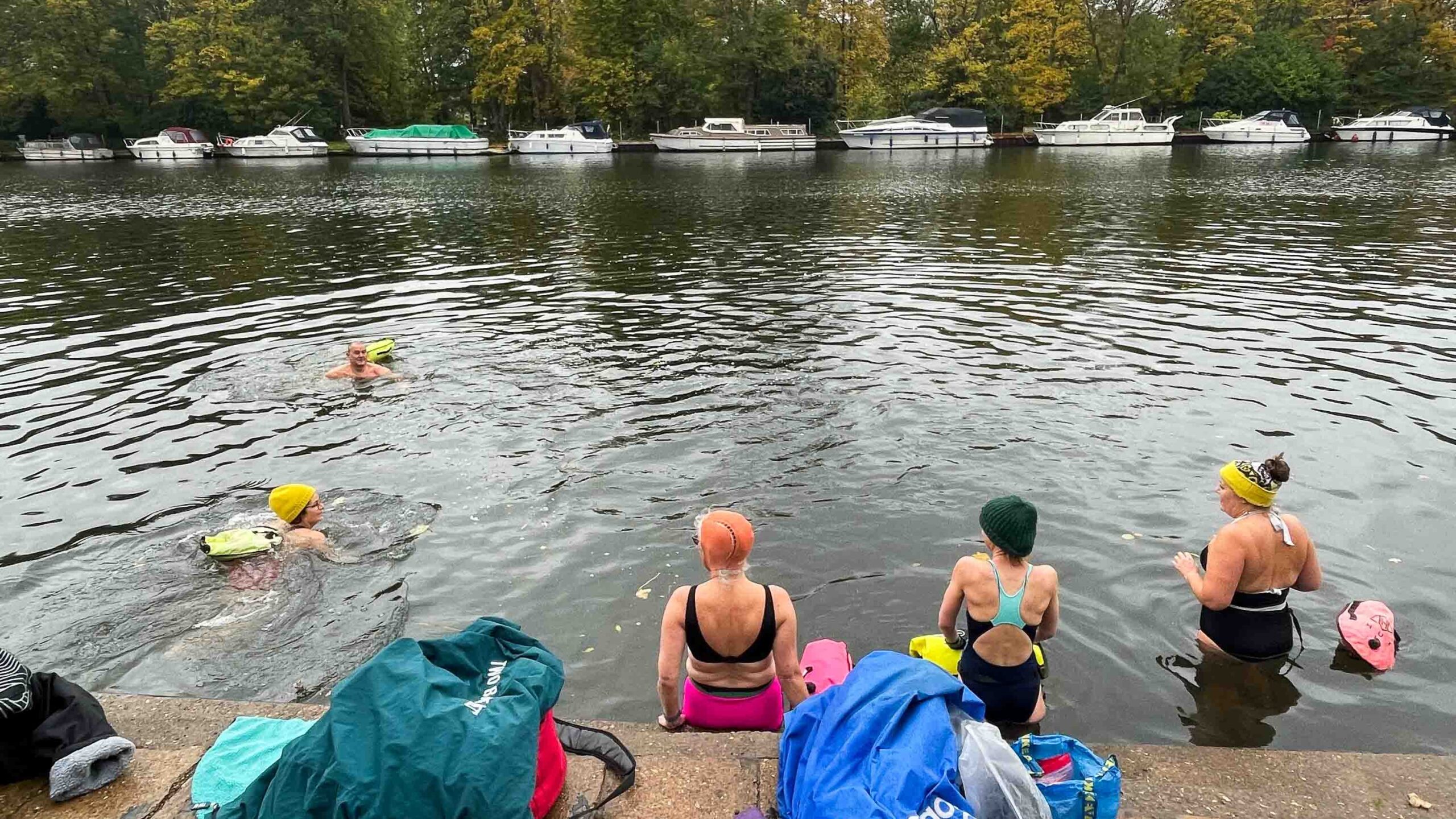
Hot summer day. Where do you go?
The city charges for everything now. The lidos are packed. The ponds have waiting lists that stretch into next week. You check the tickets, pay the premium, and still end up shoulder to shoulder with three thousand other sweating strangers.
But there is another option. One that doesn’t require a credit card.
The Thames.
It sounds reckless, right? I used to think the same thing. A murky, tidal ribbon cutting through concrete and steel. Who swims there? What are they thinking? The sewage risks? The cold shock? The history of industrial waste?
I was wrong. Not about the sewage—we have to deal with that. Wrong about the people.
Turns out, regular Londoners are doing it. Teachers, nurses, students, retirees. Fiona Jones lives in Twickenham. She has been jumping off the banks near Teddington Lock for four years straight. Year-round.
“It’s a real connection with you get away from everything,” Jones says.
She isn’t alone. The swimmers are friendly. The river is always there. Free access. That matters.
A Change in Status
As of May 15th, a stretch of the river behind the YMCA in Kingston is an official bathing water.
Before this, you could swim, sure. You just did it with a bit more anxiety.
Now, the law backs you up.
Simon Griffiths from Outdoor Swimmer Magazine pushed for this. He’s local. He wanted people to swim with confidence.
Here is the deal with the official designation. The Environment Agency monitors the water now. You can look at a chart before you get changed. It’s cleaner than you think, usually.
The main issue remains rain. When it pours, the sewage overflows trigger. That’s unpredictable. Most locals just use their heads. Skip the dip if it rained heavily in the last 48 hours. Easy enough.
If the quality dips, someone is forced to investigate. Polluters get pressured legally.
London isn’t the only city doing this. Paris opened the Seine recently. Berlin campaigners want the same for the Spree. Zurich and Munich have had open river swimming for years.
It’s an urban trend.
Don’t Swim Like It’s a Pool
Defra—the government department handling environmental stuff—had to sign off on Kingston’s status. The locals proved thousands were already swimming there. They always have.
Now we need to swim smart.
This isn’t a chlorinated square.
The water is deep. It’s cold. Ships move through.
Griffiths says it bluntly: You are responsible for your safety. What feels fine for a seasoned river runner might terrify a novice. Cold shock is real. River traffic doesn’t care if you’re naked.
Still, people flinch.
The National History Museum declared the Thames biologically dead in 1957. That image sticks. It lingers in the cultural consciousness.
Sylvia Boker grew up swimming here in the 80s. She came out covered in rashes then. The water was toxic.
She swims at Kingston today. No rash.
“The river is definitely cleaner than it was 40 years a year.”
She keeps her head above the surface. Just to be safe. Most people she tells still think she’s insane. Or brave. Maybe both. But swimming in London? It’s part of the history. Always was.
The Hard Part of Getting Official
Kingston is just one of thirteen spots getting this status across England this month. River Fowey, Canvey Island, the Swale.
It’s hard work. Kirsty Davies from Surfers Against Sewage sees this up close.
Communities volunteer. They fill forms. They beg landowners for permission. Councils get involved.
In some areas, water is seen as a hazard. A liability. Not a resource.
Davies wants to flip that script. Blue spaces are good for mental health. They are cheap. They are free.
We need more access.
It’s not peak season yet. Spring is still bracing.
But look at the data. London is getting hotter. The Thames is warming too—0.13°C every year since 2000s.
Algae blooms are getting worse. Wildlife is changing.
When we touch the water, we care about it more. An official sign saying you can swim here does something psychological. It invites us in.
Sydney does it. Portland does it. We can do it here.
Summers are getting hotter. Our cities are turning into ovens.
We need cold places that don’t charge us entry.
Come in. The water is fine.
At least today it