
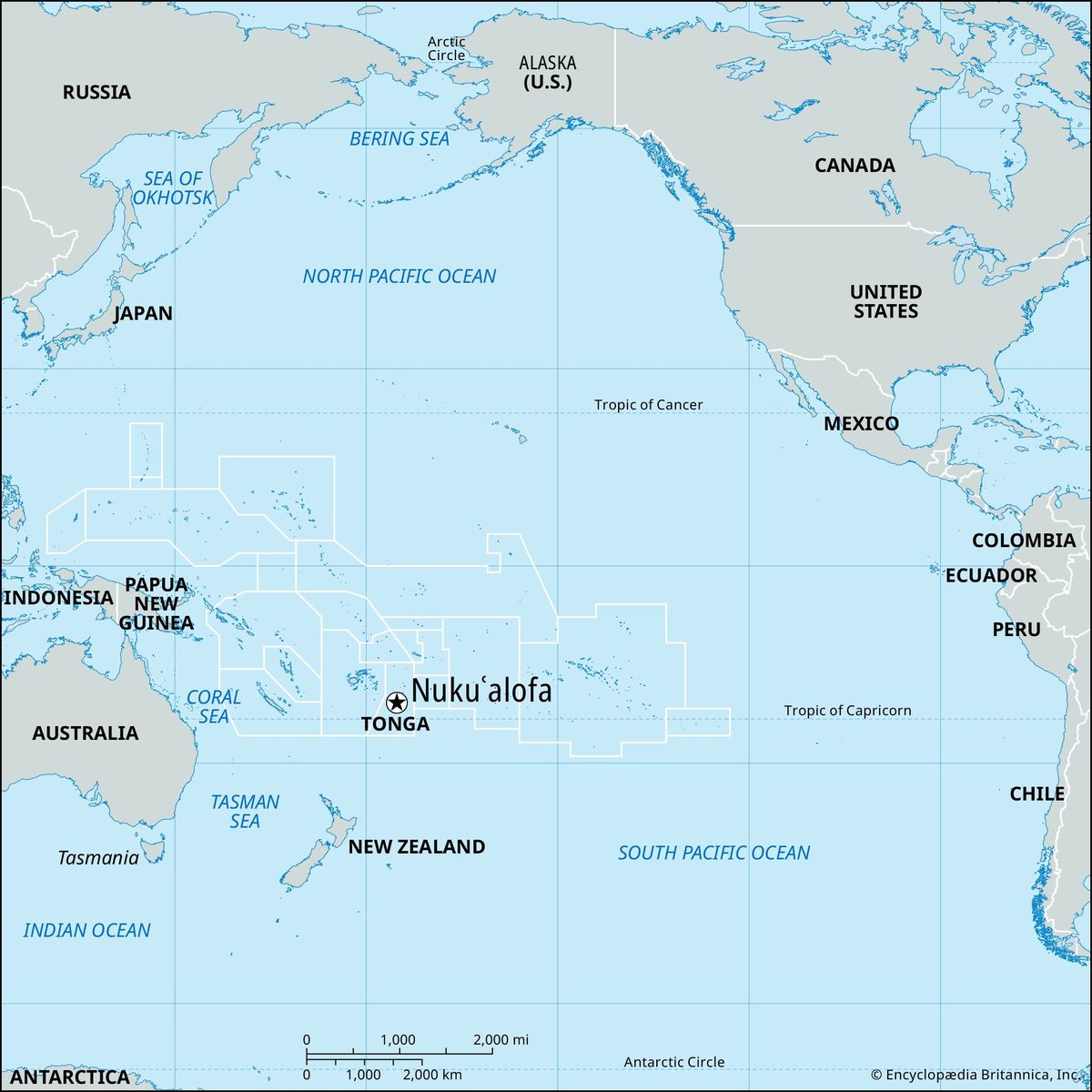
Nukuʿalofa isn’t just a dot on a map. It is the beating heart of Tonga, serving as the chief port and capital city on the northern shore of Tongatapu Island. If you are looking for deep-draft harbours protected by natural reefs, this is your spot. The southwestern Pacific setting defines everything here.
The town itself is a mix of old-world gravity and modern development. You will find the Royal Palace on the seafront, right at the end of the old wharf. Built between 1865 and 1867, it remains the home of the Tongan royal family. It is a landmark you cannot miss. Nearby lie the Royal Tombs, standing as solemn reminders of the island’s history.
Beyond the royal sites, the city functions as a hub for education and health. Several secondary schools, locally called colleges, dot the landscape. There is a teachers’ training school, Vaiola Hospital, and the government offices. A large Wesleyan church anchors the spiritual life of the community.
Modern infrastructure has crept in. You will spot a broadcasting studio and a convention centre. Just outside the town limits, there is a development housing joinery works and Copra Board enterprises. These are not just pretty names; they are the engines of the local economy.
Why Nukuʿalofa Matters for Travelers
Commercial activity in Nukuʿalofa centres on export. You will find copra, bananas, squash, and vanilla being prepped for shipment. This is also where you buy traditional handicrafts. The fishing fleet operates out of the harbour, bringing in tuna and snapper. As the main market for fishery products in Tonga, the smell of fresh catch is often in the air.
A government-run industrial estate, the Small Industries Centre, leases factory facilities to various industries. If you are interested in how local manufacturing works, this is a place to peek inside.
Getting there and getting around requires some planning. Fuaʿamotu International Airport is not in the city. It sits some 15 miles, or 24 km, to the southeast by road. You will need to account for that drive if you are tracking logistics.
“The town has several secondary schools (called colleges), a teachers’ training school, Vaiola Hospital, government offices, and a large Wesleyan church.”
The contrast between the deep-draft harbour and the shallow lagoons is striking. This geography dictates trade. It dictates how you move through the city. It dictates what you see.
You might wonder which is better for a first-timer: the historic Royal Palaces or the bustling market stalls. The answer depends on how much you value quiet reflection versus sensory overload. Both exist in Nukuʿalofa.
The export of vanilla and squash might seem mundane to some. To others, it is the taste of the island. The Copra Board enterprises show how a single crop can sustain a town. It is not glamorous. It is honest work.
Modern buildings rise alongside older structures. The broadcasting studio signals connectivity. The convention centre suggests growth. But the royal family’s home remains a constant.
This is not a city designed for speed. It is designed for function. And for visitors,
The 2006 Riots and Nukuʿalofa’s Hard-Won Recovery
The story of modern Nukuʿalofa isn’t just about coral reefs and cruise ships. It is also a story of political friction that nearly burned the city to the ground.
In the early 2000s, a pro-democracy movement gained serious traction across Tonga. The government responded by forming a national committee for political reform. Their report, delivered in 2006, laid out a path for change. The legislature reviewed it. Then, they did nothing.
The failure to act on those recommendations triggered immediate unrest. Riots erupted in the capital. They were not small skirmishes. The central business district took a massive hit. Four-fifths of it was destroyed.
Reconstruction and the New Wharf
The aftermath left a city in shambles. But reconstruction didn’t wait for comfort. It began immediately.
The project lasted several years. It wasn’t just about sweeping up glass. It was about rebuilding infrastructure from the ground up. By 2012, the work was complete.
They restored the historic buildings. They paved the roads. They also built a new wharf for the port. This upgrade wasn’t just cosmetic. It changed how goods and visitors arrive in the city.
If you are planning a trip, know that the city you see today is post-revolution. The streets are paved. The wharf is new. The scars of 2006 are gone, replaced by functional modernity.
Visiting Nukuʿalofa Today
Pop. (2006) city, 23,658; urban agglom., 34,311.
The numbers are static. The vibe is not.
When you walk through the city now, you might not see the chaos of that night. You see a port that handles traffic more efficiently. You see buildings that survived the fire. You see a capital that had to reinvent itself after being told to change and then ignored.
It is a small city. But it has a loud history.
The reconstruction finished in 2012. The wharf opened. The tourists came back. The locals stayed.
The question is why this matters to you. It matters because the infrastructure is better. The port is newer. The roads are intact. But it also matters because the city chose to rebuild rather than abandon itself.
You can stand on that new wharf. You can look at the restored streets. You can remember that peace here was bought with fire.
Does that make the visit more meaningful? Maybe. Or maybe it just makes you aware that stability is fragile.
Either way, the city is open. The wharf is working. The streets are clean.
Go see it.