Riverside is more than just a place of transit. This is the center of the eastern loop of the Inland Empire. Located on the banks of the Santa Ana River, this urban complex extends toward San Bernardino and Ontario, forming a dense urban area east of Los Angeles. If you’re planning a trip here, don’t just look at the traffic map. Look at the history. And the oranges.
Where it all began: the legacy of navel oranges
This town has a strange and special origin story. It was built in 1870 at Rancho Jurupa after a land grant from Mexico in 1838. Originally called Jurupa, it started as an silk-growing colony. It failed. The climate is wrong. But what about the soil? Perfect for citrus fruits.
After changing its name to Riverside, it soon turned to the orange industry. In 1873, the first Washington pole orange tree was planted in the state. These are not in stock locally. Propagated by Brazilian cuttings. This single agricultural gamble defined the town’s economy for decades.
This legacy is now preserved at the California Citrus State Historic Park. You can walk through the restored village and see the Parent Navel Orange Tree for yourself. It is still alive. It has more than 150 years of history. It is a peaceful monument surrounded by trees that shows what happens when a group gets the right fruit.
Education, industry, and Airfields
Riverside’s economy has diversified, but its roots remain. Manufacturing, distribution and education are key. University of California, Riverside (founded 1954) is still a citrus experimental station. They are still examining the fruit.
The city is also a center of higher education. La Sierra University (Seventh-day Adventist, founded 1922) and California Baptist University (founded 1950). The community college has been here since 1916. This is an academic town with a working-class backbone.
Next is the military side. March Air Reserve Base (March Air Force Base until 1996) is nearby. Not just active duty. The base has a field museum that displays vintage aircraft. If you’re interested in aviation history, this is a fulfilling half-day tour.
Hiking, rock climbing, outdoor spaces
There are some not exactly obscure outdoor attractions along the river. At the northern end, the Santa Ana River Regional Park offers green areas and access to the river. To the south of the city is Lake Mathews. Although it is a reservoir, it is also a popular place for boating and walking.
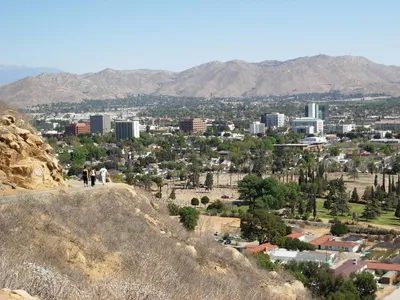
For mountain climbers, Mount Rubidoux is the most attractive place. The elevation is 1,399 feet (426 meters). This is not Mount Everest. However, it is a popular spot for slab rock climbing. You can see the whole valley from the top. On a clear day you can see the San Gabriel Mountains.
The area continues to expand beyond the city limits. Lake Perris State Recreation Area is a short drive south. Mockingbird Canyon and Sycamore Canyon Park offer hiking and canyon exploration. It’s inland