Everything Everywhere Daily isn’t just another history podcast. It’s a dense, 36-hour-long intellectual workout.
But if you want to understand modern economics, you have to go back. Way back. To 1776.
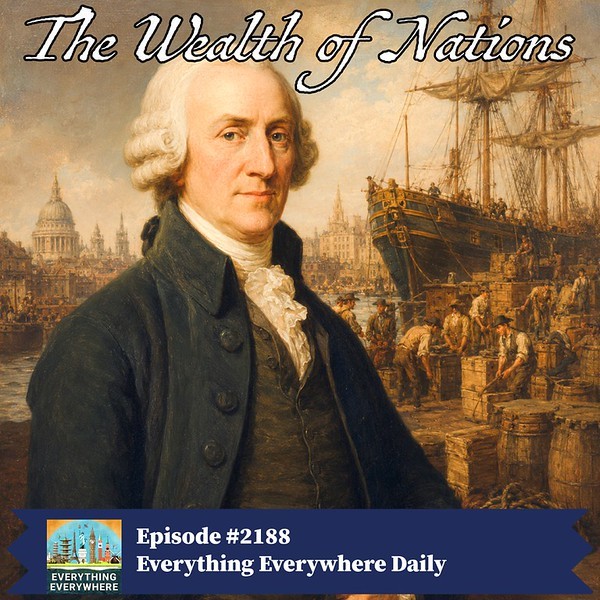
That year gave us the Declaration of Independence. But it also gave us The Wealth of Nations. Adam Smith’s masterpiece. A dense, sprawling book about trade and labor that changed everything.
It wasn’t a textbook. It was a moral philosophy project disguised as economic theory. And most people get it wrong.
The Man Behind The Theory
Adam Smith was a Scot. Born in Kirkcaldy in 1723.
He entered university at fourteen. Young, brilliant, hungry. He studied under Francis Hutcheson. Hutcheson taught him about reason and liberty. Smith loved it.
Then he went to Oxford.
Disaster.
Smith later wrote that the professors at Oxford had given up teaching. Just the pretense. So he left. He taught logic. Then moral philosophy. And while sitting in that chair, he wrote The Theory of Moral Sentiments.
That book came out in 1759. Most people haven’t heard of it. Smith considered it his better work. Why? Because The Wealth of Nations isn’t a standalone text. It’s the second half. The second half of a big project on human nature. You can’t understand the economy if you ignore the morality.
But how did he afford to write the big one?
Luck.
A politician named Charles Townshend read Moral Sentiments. Liked it. Hired Smith to tutor his nephew, the Duke of Buccleuch. A grand tour of Europe was in order. Paris. Geneva. Toulouse.
Smith got bored.
France was slow. The young Duke got sick. They left early. But Smith stayed on in France for a bit, hanging out with the physiocrats. French thinkers. They obsessed over agriculture and natural order. It impressed Smith. Deeply.
When they went home to Scotland, the Duke paid Smith well. Very well. A pension for life.
Smith used that money. He took care of his mom. He led local clubs. And for ten years, he wrote. He poured all that European boredom and Scottish pride into a single project.
By 1776, he finished.
Why Gold Is Boring
The prevailing idea back then was mercantilism.
Sound fancy? It’s actually boring. Mercantilists thought national wealth was measured by how much gold and silver a country had in its vault. To get rich, you export. To stay poor, you import. Build walls. Tariffs. Monopolies. Suck wealth from your colonies.
Smith said: No.
Gold is just a medium of exchange. Its value fluctuates. Holding gold isn’t wealth. It’s just sitting there.
Real wealth is the stuff people produce and consume. The “annual produce of the land and labour of society.” It’s dynamic. It moves.
This was radical. Wealth isn’t a hoard. It’s a flow.
The Pin Factory And The Sad Truth
Smith loved an example. The pin factory.
One worker tries to make pins alone. He might make a few a day. Struggling.
Now, split the work.
One pulls wire. One straightens it. One cuts it. One sharpens the point. Another attaches the head. Suddenly, production skyrockets.
This is the division of labor. Specialization creates wealth. You get better at one thing. You save time. You invent new tools to do it faster.
But Smith wasn’t a cheerleader. Not really.
He saw the dark side. If you do the same tiny task all day, your mind atrophies. You become stupid. Narrow.
In Book V, Smith argued for public education. Why? To counter the mental dullness caused by industrial work. He wasn’t blind to the human cost of productivity. He knew specialization came with a price.
It’s Not About Being Nice
This leads to the famous line. The one every econ 101 student memorizes and misuses.
“It is not from the benevolence of butcher, the brewer or the baker that we expect to get our dinner but from their regard of their own interest.”
People read this and think Smith is saying selfishness is good.
He’s not.
He’s saying something much more pragmatic. Strangers don’t need to be friends to trade. They just need self-interest.
The baker doesn’t need to love you. He needs your money. You don’t need to love the baker. You need bread. Exchange allows peace among strangers. It coordinates society without needing a king to shout orders.
Smith analyzed where money goes.
Wages go to workers. Profit goes to capitalists (those who own stock and tools). Rent goes to landowners.
Did he think these groups agreed on everything? Absolutely not.
He was actually suspicious of businessmen.
He warned that merchants often collude to raise prices. He wrote, bluntly:
People of the same trade seldom meet even for merriment and diversion, but the conversation ends in a conspiracy, either against the public, or some contrivance to raise the price.
Smith cared about the poor. Not the rich. He argued that if most people are miserable, society can’t be called prosperous. High wages? That’s a sign of a healthy nation. Low wages? That’s sickness.
The Invisible Hand Is A Metaphor, Not A Myth
Here’s the twist.
The “invisible hand.” Everyone quotes it. But in The Wealth of Nations, it appears exactly one time.
Not in the chapter on free trade. Not in the pin factory chapter. It’s in a section about domestic vs. foreign investment.
Smith is worried investors will send their money overseas, where it’s less regulated. He points out that by trying to secure their own capital, investors naturally tend to invest at home. And in doing so, they unintentionally benefit society.
“Led by an invisible hand.”
That’s it. That’s the context.
It’s not a cosmic force. It’s not a divine guarantee that capitalism will always save you. It’s a subtle point about conditions. Under specific conditions—like fair competition, justice, and rule of law—self-interest can lead to social good. Remove those conditions? The hand disappears. Corruption takes over.
Attack On The Empire
Smith wasn’t just talking abstract theory. He was attacking the British government.
Book IV of the book is a direct hit on mercantilism. Specifically, on colonial policy.
Smith argued that the British system of controlling the American colonies was bad for everyone. Even bad for Britain. It favored a narrow class of merchants while stifling broader growth. It was irrational.
He believed commerce should be free.
And he flipped the script on the purpose of the economy.
Most policy was written for the producer. The manufacturer. Smith said the purpose of all production is consumption. The economy exists to serve the consumer. Everyone. The person eating the bread. The person wearing the clothes.
This was dangerous talk. It challenged the entire reason Britain existed as an empire.
Why It Matters
Smith’s legacy is huge. Not because every word was right. But because he changed the conversation.
Before him, wealth was about kings and treasuries. After him, wealth was about labor and living standards.
Influences flowed out from his book. Ricardo. Malthus. Mill. Even Marx worked in the framework Smith built, even while trying to tear it down.
In 1846, long after Smith was dead, the British Parliament repealed the Corn Laws. These were tariffs protecting domestic farmers. Free trade won. Smith won.
His framework holds up not because the market is perfect. It holds up because it recognizes a reality. Commercial society is flawed. Morally complicated. Prone to monopoly. But it can lift people out of poverty better than almost any alternative. If it is guarded well.
Everything Everywhere Daily Executive Producer is Charles Daniel. Associate producers are Austin Oetken and CameronKieffer.
A few words from the listeners.
g_hat on Apple Podcasts called it a “gem.” Says the variety keeps him engaged. Thanks to him.
Haoli44 called it “Always worth the time.” Likes the concise description of topics. Good enough to know whether to dive deeper.
Thanks for listening.
The host admits he’s behind on reading reviews. It takes time. If you write one, he’ll read it eventually. Just keep listening.
Because the world is complex. And understanding how wealth moves helps you navigate it. Maybe.