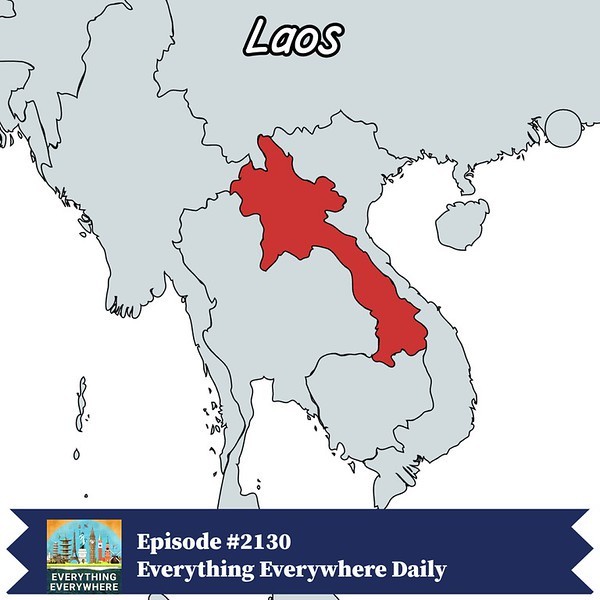
Laos is frequently described as the “forgotten nation” of Southeast Asia. Sandwiched between giants—China, Vietnam, Thailand, Cambodia, and Myanmar—it rarely dominates global headlines. Yet, to overlook Laos is to ignore a history defined by extreme contrasts: it is a landlocked country sustained by one of the world’s greatest rivers, a tropical biodiversity hotspot that was also the most heavily bombed nation in history.
Understanding Laos requires looking past its quiet present to a past shaped by imperial ambition, colonial exploitation, and Cold War proxy conflicts. Its story is not just one of survival, but of how geography and external powers have dictated its fate for centuries.
The Mekong: Lifeblood of a Landlocked Kingdom
Geography is the primary driver of Laotian history. Unlike its neighbors, Laos has no coastline. This landlocked status traditionally imposed significant economic and strategic disadvantages, limiting trade access and military mobility. However, this isolation is mitigated by the Mekong River.
The Mekong is not merely a border; it is the infrastructure of Laos. As the twelfth-largest river in the world, it flows through the heart of the country, serving three critical functions:
- Food Security: The river hosts the largest inland fishery globally. For lowland Laotians, freshwater fish provides approximately 90% of their dietary protein.
- Agriculture: The Mekong’s waters irrigate vast rice fields, supporting a culture with one of the highest per-capita rice consumption rates worldwide.
- Transport and Trade: Historically and currently, the river serves as the primary artery for moving goods and people, connecting the interior to Cambodia, Vietnam, and eventually the sea.
Because of this reliance, the Mekong is often described as Laos’s “substitute for the sea.” The river’s ecosystem is equally vital, supporting an estimated 500 fish species, including critically endangered ones like the Irrawaddy dolphin and the Siamese crocodile. Laos remains one of the most biodiverse nations on Earth, hosting thousands of plant species and endangered mammals such as the Indochinese tiger and Asian elephant.
From Lan Xang to Colonial Fragmentation
Human habitation in the region dates back at least 46,000 years, with archaeological evidence of bronze and iron working appearing around 1500 BC. However, the political identity of Laos coalesced in the 14th century with the founding of the Kingdom of Lan Xang (“Million Elephants”).
Founded by Prince Fa Ngum in 1353, Lan Xang unified disparate principalities along the Mekong. Fa Ngum, who had been exiled to the Khmer Empire (modern-day Cambodia), returned with military support and introduced Theravada Buddhism as the state religion, along with Khmer administrative structures. While Lan Xang became a major trade hub under his son, it collapsed into centuries of instability after 1421.
For four centuries, the region was fragmented, plagued by Burmese invasions and internal power struggles. This weakness attracted the attention of European colonial powers. In the late 19th century, France sought to expand its influence in Indochina. By leveraging military assistance against threats like the Chinese “Black Flag Army,” France established a protectorate over the Kingdom of Luang Prabang in 1893.
Following a crisis with Siam (modern Thailand), France gained control of the eastern bank of the Mekong. The territory was renamed Laos after its largest ethnic group. Under French rule, Laos became a minor producer of rubber, tin, and coffee, contributing less than 1% to French Indochina’s exports. France invested little in development but encouraged Vietnamese migration to fill labor shortages, creating ethnic tensions that persist in historical memory.
The Secret War: Bombing and Civil Conflict
World War II saw Japanese occupation of Laos, which served primarily as a buffer zone and prison location. After Japan’s defeat, French forces attempted to reassert control, sparking a nationalist resistance led by the Pathet Lao, a communist movement aligned with the Vietnamese Communist Party.
Laos gained nominal independence in 1953 as a constitutional monarchy, but stability remained elusive. The Cold War soon turned the country into a battlefield. As the Vietnam War intensified, North Vietnam used Eastern Laos as a critical supply route—the Ho Chi Minh Trail —to move troops and supplies to the South.
The United States, aiming to disrupt this flow, launched a covert aerial campaign known as the “Secret War.” Between 1964 and 1973, the U.S. dropped over 2 million tons of bombs on Laos. This included more than 270 million cluster munitions.
Contextual Impact: This makes Laos the most heavily bombed country per capita in history. The bombing campaign devastated infrastructure, killed tens of thousands of civilians, and left behind millions of unexploded ordnance (UXO) that continue to threaten communities today.
By 1964, Laos was effectively split: a communist-controlled north and east backed by North Vietnam, and a monarchist south and west backed by the United States. The conflict ended with the communist victory in 1975, leading to the establishment of the Lao People’s Democratic Republic. Approximately 10% of the population fled as refugees.
Modern Laos: Stability Amidst Constraints
Today, Laos remains a one-party state under the Lao People’s Revolutionary Party (LPRP). Major decisions are made by an inner circle of eleven elites, and while elections occur every five years, they are neither free nor competitive.
Despite its political rigidity, Laos has emerged as a unique destination in Southeast Asia. Unlike its neighbors, which have seen massive tourism booms, Laos retains a slower pace and fewer crowds, particularly in historic cities like Luang Prabang and the capital, Vientiane.
The country faces ongoing challenges, including the legacy of unexploded ordnance and economic dependence on hydropower and mining. Yet, its resilience is evident. From the ancient Kingdom of Lan Xang to the scars of the Cold War, Laos has maintained its cultural and geographical integrity.
Conclusion: Laos is more than a quiet transit point between regional powers. It is a nation whose history reveals how geography, colonialism, and global conflict can shape a small country’s destiny. Its story serves as a reminder that even nations that rarely make headlines can hold profound historical significance.