
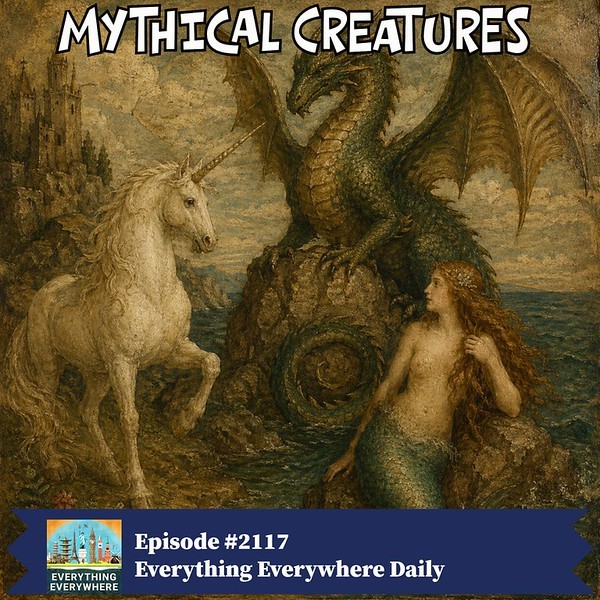
For millennia, humanity has populated the edges of the map with monsters, gods, and hybrids. From the untamable unicorn to the fire-breathing dragon and the alluring mermaid, these creatures have shaped our art, religion, and literature.
While we now know these beings do not exist, their origins are not purely products of imagination. Instead, they are often the result of misinterpreted biology, misunderstood natural phenomena, and the human need to explain the unknown.
The Unicorn: From Ferocious Beast to Symbol of Purity
The modern image of the unicorn—a graceful white horse with a single spiral horn—is a far cry from its ancient descriptions. The evolution of this myth shows how a creature can be completely “rebranded” by different cultures to serve their own values.
Ancient Misidentifications
The earliest traces of the unicorn appear in the Indus Valley Civilization (3000–1300 BC) on clay seals, though scholars debate whether these depict unicorns or ancient aurochs. Later, Greek writers like Ctesias described “wild horses” with large horns, which historians believe were likely descriptions of various antelope species.
The Roman Influence
The Roman author Pliny the Elder provided one of the most influential—and bizarre—descriptions in his Naturalis Historia. Rather than a horse, Pliny described a creature with the head of a stag, the tail of a boar, and the feet of an elephant. He also characterized the unicorn as a ferocious, untamable beast, cementing its reputation as a creature of power and wildness.
The Christian Transformation
The unicorn’s shift from a fierce animal to a symbol of grace occurred through religious reinterpretation:
– Linguistic Errors: A mistranslation of the Hebrew word for “ox” as the Greek monokeros (one-horn) helped weave the creature into early Christian texts.
– Symbolic Purity: In the Physiologus, the myth evolved to suggest that a unicorn could be calmed only by a “pure” maiden.
– Divine Association: Because the horn was believed to purify water, the unicorn became a metaphor for Jesus Christ, representing holiness and untainted virtue throughout the Middle Ages and the Renaissance.
Dragons: The Power of the Fossil Record
Unlike the unicorn, which was often a singular, elusive beast, dragons appear across nearly every major civilization. This global phenomenon suggests a common root: the discovery of prehistoric remains.
The Biological Explanation
The most widely accepted theory is that ancient people stumbling upon dinosaur fossils interpreted the massive bones and skulls as evidence of giant, scaly monsters.
- Mesopotamia & Persia: The muššuššu was a protective, serpent-like deity in Babylon, while Persian legends spoke of the Aždahā, a winged, fire-breathing beast.
- China: For 4,000 years, Chinese dragons have symbolized luck, fortune, and imperial legitimacy. Interestingly, “dragon bones” were used in traditional medicine; archaeological finds suggest these were actually the fossilized remains of other creatures or even Homo erectus.
- Europe: European dragon myths often centered on conflict. In 13th-century Austria, a local legend of a dragon was “confirmed” when townspeople found a massive skull. It was later identified as the skull of an extinct woolly rhinoceros, yet the myth persisted for centuries.
Whether viewed as a divine protector in the East or a monster to be slain by saints in the West, the dragon represents humanity’s attempt to personify the overwhelming power of nature.
Mermaids: Sailors, Sirens, and Sea Mammals
The myth of the mermaid—a human-fish hybrid—is one of the oldest, with roots stretching back to Babylonian and Assyrian deities like Oannes and Atargatis. However, the modern “alluring woman” is a composite of several different legends.
The Evolution of the Siren
In Greek mythology, Sirens were not fish-women; they were half-human, half-bird creatures who lured sailors to their doom with their voices. Over time, the concept of the dangerous sea-woman merged with other aquatic myths, eventually adopting the fish-like anatomy we recognize today.
Cultural Variations
- Celtic Folklore: Irish myths introduced “sea faeries” and selkies (seals that could transform into humans). Unlike the dangerous sirens, these creatures were often portrayed as sweet or docile, shifting the mermaid myth toward a more romanticized view.
- The “Manatee” Effect: Perhaps the most practical explanation for mermaid sightings comes from the sailors themselves. Long periods at sea, isolation, and even scurvy or alcohol likely led sailors—including figures like Christopher Columbus—to mistake manatees or dugongs for beautiful women. In the dim light and rolling waves, a large marine mammal can easily be mistaken for a human torso.
Conclusion
Mythical creatures serve as a bridge between reality and the human psyche. While science has demystified their origins—pointing to fossils, misidentified animals, and maritime illusions—these legends remain vital. They reveal that throughout history, humans have used fantasy not just to explain the world, but to express their deepest desires for purity, power, and mystery.