
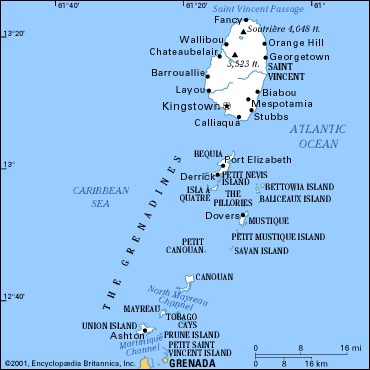
If you’re looking for the pristine Caribbean you remember from 30 years ago, look no further. St. Vincent and the Grenadines is that place. Located in the Windward Islands of the Eastern Caribbean, the country feels more like a living ecosystem than a tourist trap. The country consists of the main island of St. Vincent and a group of smaller islands called the Grenadines. At just 388 square kilometers, the island is small enough to conquer but big enough to hide its secrets. It has a population of about 111,800 people, most of whom are African, and has developed a rich Caribbean culture. You can hear English everywhere. It’s the official language, so you don’t need to learn a new dialect to visit markets or book ferries.
The landscape itself is dramatic. Volcanic rock forms the foundation of every inch of land here. Forested mountains stretch from north to south, and are cut by fast-flowing rivers. This is not a flat sandy beach or a calm lagoon. This is vertical. The highest peak is Mount Soufrière, with a height of 1234 meters. It is an active volcano and has experienced repeated catastrophic eruptions throughout its history. When you wander there, you walk through history. The atmosphere is changing. The soil is fertile. Agriculture is the mainstay of the economy here, with bananas and arrowroot being the main export crops. Kudzu in particular has been cultivated on the island for centuries. It is a niche crop that defines the character of the region. Tourism supports this economy, but it is not yet widespread.
Why St. Vincent is the antidote to mass tourism
You might ask, which Caribbean island feels more realistic in 2026? The answer is almost certainly rarely the one with the mega-resorts. St. Vincent offers a different kind of luxury. This is a luxury space. The luxury of not seeing other cruise ships at the docks. The currency is the Eastern Caribbean dollar, whose value is pegged to a basket of currencies that includes the US dollar. It’s solid, but you’re still doing mental math while paying for a cab. The cost of living is lower than Barbados or Antigua, but the simpler infrastructure means a better quality of life for visitors. Simple means clean. Simple means less clutter.
The history here is very rich. France and England fought over this land until 1763, when it was ceded to England by the Treaty of Paris. However, the first inhabitants of the Caribbean did not fully accept this reality. In 1795 they rebelled. Most were deported. Many of those who remained died in eruptions in 1812 and 1902. You can feel that resilience. This was a society that survived conquests, natural disasters and colonial changes. The current government is a constitutional monarchy. The British monarch is the head of state and is represented by the Governor-General. The Prime Minister is responsible for day-to-day operations. This system has been in place since 1979, when the country achieved full independence. This stability allowed tourism to grow organically after the country self-governing state in association with the UK in 1969 and became a self-governing nation.