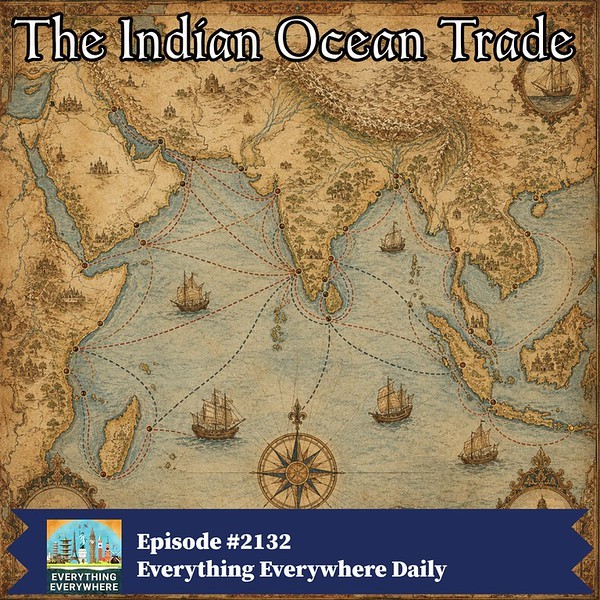
Long before steamships chugged across the oceans or Europeans mapped the Atlantic, the Indian Ocean served as the central nervous system of the ancient world. It was not merely a body of water but a dynamic commercial highway that connected Africa, Arabia, India, Southeast Asia, and China.
For millennia, this network facilitated more than just the exchange of spices and silk; it transmitted religions, technologies, and cultural norms. The Indian Ocean trade system was the original globalization event, creating a sophisticated, interconnected economy that predated the modern world by centuries.
Cracking the Monsoon Code
The foundation of this vast network was not advanced technology, but meteorological knowledge. For early mariners, the Indian Ocean was a barrier until they understood the monsoon winds.
The monsoon is a seasonal reversal of wind patterns driven by the heating and cooling of the Indian subcontinent:
* Summer (May–September): Winds blow from the southwest to the northeast, carrying ships from Africa and Arabia toward India and Southeast Asia.
* Winter (October–April): Winds reverse, blowing from the northeast to the southwest, allowing merchants to return home.
While Western history often credits the Greek merchant Hippalus with “discovering” these winds, sailors in the region had mastered this pattern generations earlier. This predictability transformed the ocean from a barrier into a reliable conveyor belt. By timing their voyages to the wind shifts, merchants could travel long distances with relative speed and safety, linking ports from East Africa to the Malay Peninsula.
The Vessels and the Voyagers
Technology played a crucial supporting role. The dhow, a traditional sailing vessel with a distinctive lateen (triangular) sail, revolutionized navigation. Unlike square sails, lateen sails allowed ships to tack against the wind, providing greater maneuverability in the variable conditions of the Indian Ocean.
Combined with the astrolabe and the compass, these innovations enabled extraordinary feats of exploration. Most notably, the Austronesian peoples —seafaring legends originating from Taiwan—navigated the open ocean to settle Madagascar in the first millennium AD. This journey marked one of the earliest instances of long-distance, open-ocean colonization in the region.
Islam and the Standardization of Trade
A pivotal shift occurred in the 7th century with the rise of Islam. As Muslim merchants from Persia and Arabia became dominant in the region, they introduced a standardized commercial framework that drastically increased efficiency.
Before this period, traders navigated a patchwork of conflicting legal traditions and commercial practices. Islam provided a unified ethical and legal basis for commerce. Key innovations included:
* Letters of Credit: These financial instruments allowed merchants to conduct large transactions without carrying heavy loads of coin, reducing risk and simplifying trade.
* Religious Unity: Shared faith created trust networks across vast distances, facilitating smoother negotiations between merchants from diverse backgrounds.
Under the Abbasid Caliphate, demand for luxury goods—particularly spices from Southeast Asia and silk from China—skyrocketed, fueling a boom in commercial activity.
The Emporia: Hubs of Cultural Fusion
The heart of the Indian Ocean trade was not a single capital city, but a network of emporia —coastal trading hubs like Zanzibar, Calicut, and Malacca. These were not just markets; they were melting pots.
Because the monsoon winds dictated travel schedules, merchants could not simply drop off goods and leave. A trader arriving in India in June would often have to wait until October for the winds to reverse. This forced six-month residency led to deep cultural immersion:
* Ethnic Enclaves: Distinct communities formed, such as Persian quarters in Zanzibar or Arab neighborhoods in Calicut.
* Linguistic Blending: Languages evolved through contact. Swahili, for example, developed from Bantu roots with significant Persian and Arabic influences.
* Technological Diffusion: Innovations like papermaking and the compass spread rapidly through these resident merchant communities.
Nowhere was this diversity more evident than in Malacca. Located at the strategic chokepoint of the Strait of Malacca, the city was a cosmopolitan powerhouse. In 1511, Portuguese observer Tomé Pires recorded that 84 different languages were spoken in a population of only 50,000. It was a place where Chinese, Arab, Indian, and Malay merchants coexisted in a relatively egalitarian system, driven by commerce rather than conquest.
The End of the Peaceful Era
For a thousand years, the Indian Ocean trade was characterized by a balance of power. No single empire dominated; instead, the “environment dictated the terms,” allowing various groups to carve out niches based on their goods and navigational skills.
This delicate equilibrium shattered in the late 15th century. The Treaty of Tordesillas (1494) divided the non-European world between Spain and Portugal, granting Portugal exclusive rights to the African and Indian Ocean routes.
Portuguese explorer Vasco da Gama arrived in India in 1498, marking the beginning of European imperial intrusion. Unlike previous traders who integrated into local systems, the Portuguese aimed to dominate them. They established a “Trading Post Empire,” using superior naval firepower to enforce monopolies and disrupt traditional networks.
The shift from peaceful commerce to imperial conflict was stark. The Battle of Diu (1509) saw the Portuguese repel an Ottoman-Egyptian coalition, cementing European hegemony. The subsequent introduction of the cartaz system (naval passes) and the arrival of other European powers like the Dutch and British East India Companies transformed the region’s ports from independent hubs of cultural exchange into subordinate nodes in colonial empires.
Conclusion
The history of the Indian Ocean trade is a testament to human connectivity. Before the age of imperialism, merchants riding the monsoon winds created a resilient, multicultural web that linked the East and West. While European intervention eventually dismantled this autonomous system, the cultural and economic foundations laid during those centuries continue to shape the modern global landscape.