As a journalist who spent decades at institutions like The Wall Street Journal and The New York Times, I have trained myself to report only what I can verify. Yet, there are experiences that defy standard explanation—phenomena that exist in the gap between optical illusion and personal revelation.
One week after my father’s death, my mother and I were walking the ridgelines of Tennessee’s Smoky Mountains. It was a clear April afternoon, devoid of rain or prisms that might refract light. Suddenly, a shaft of colored light—shifting blues and greens—appeared in the air before us. It was not a reflection on a screen, nor a smudge on a lens. My mother raised her camera; I watched with my naked eye. For a few minutes, this luminous presence hovered, moving as we moved, until it simply vanished without warning.
Skepticism is natural, but context matters. While critics might dismiss this as a camera artifact or lens flare, the fact remains that two people witnessed the same phenomenon simultaneously in open air. More importantly, this event has returned every April since his death—ac different states, different devices, and different landscapes—always lasting only a few minutes before disappearing without explanation.
I have stopped trying to scientifically explain these occurrences. Instead, I have learned to simply show up for them.
The Question of Richness
My parents believed that travel was not a break from family, but an extension of it. When I was eight, they took me to Stonehenge. Standing before the ancient stones, my father posed a question that has shaped my understanding of experience ever since.
He had spent his life reading about Stonehenge, imagining it, and longing for it. At 37, he finally stood in its presence, carrying a lifetime of anticipation. I, at eight, had no context. I saw only stones. But he asked: “Who is the richer? The one who arrives with a lifetime of knowledge, or the one who arrives with nothing but presence?”
He suggested that while he had the knowledge first and the place second, I would have the place first. Years later, when I read about Stonehenge in school, I would not be learning something new; I would be recognizing something I had already felt with my body.
Carhenge: A Monument to Patience
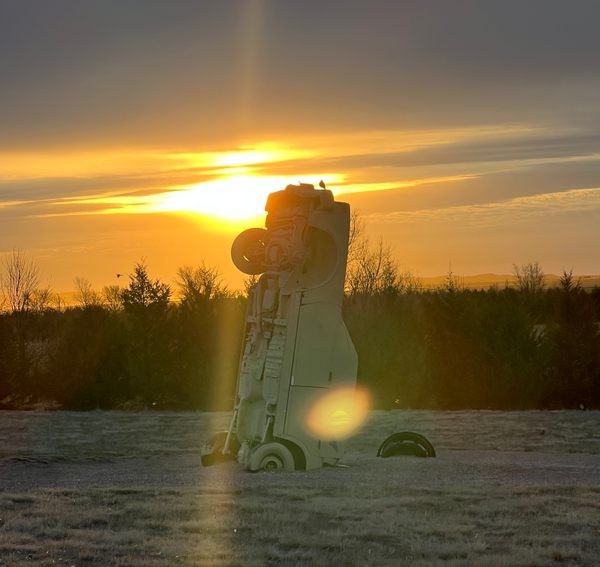
This morning, I drove to a field in Nebraska before dawn to visit Carhenge. Located outside Alliance, this full-scale recreation of Stonehenge is built from 38 vintage American cars, painted grey and buried hood-deep in the earth. It is absurd, yet at sunrise, it is inexplicably beautiful.
I arrived alone. The grey cars were silhouettes against the pale sky. Over the next 90 minutes, the light did not just illuminate the site; it transformed it repeatedly. The grey turned to amber, shadows stretched across frost-pale grass, and rust beneath the paint caught fire as the sun climbed.
Most visitors stop for ten minutes, take a photo, and leave. But Carhenge is not a ten-minute place. It is a place that keeps becoming something else. If you leave before it is done with you, you have not truly been there.
Because I stayed, I witnessed something else. In twenty photographs taken from various angles, a soft, luminous green circle appeared in the frost-covered grass. It was not the sun, nor a reflection. It was a quiet, round presence that lasted about ten minutes before vanishing—just as it had in Tennessee.
The Architecture of Memory
Carhenge was built in 1987 by Jim Reinders as a memorial to his father. Reinders gathered his family on their Nebraska homestead, painted the cars grey, and arranged them with precise correspondence to the original Stonehenge’s dimensions and orientation. He built it not for funding or permission, but out of love and audacity.
Standing in the frost, reading this history five years after my father’s death, the parallels were undeniable. My father would have appreciated Reinders’ refusal to wait for approval. He would have admired the sheer will to rebuild an ancient monument in the middle of the American Midwest.
He would have also pondered the question of richness again. Who is richer: the pilgrims at the original Stonehenge, surrounded by thousands of seekers, or those who drive through the Nebraska sandhills to find silence and solitude?
Conclusion
I believe my father would have stayed long enough to let the light change. He would have understood that meaning is not always something you extract, but something you inhabit.
The light was there. I was there. And for ten minutes, in the silence of a field built by a son for a father, he was there too.