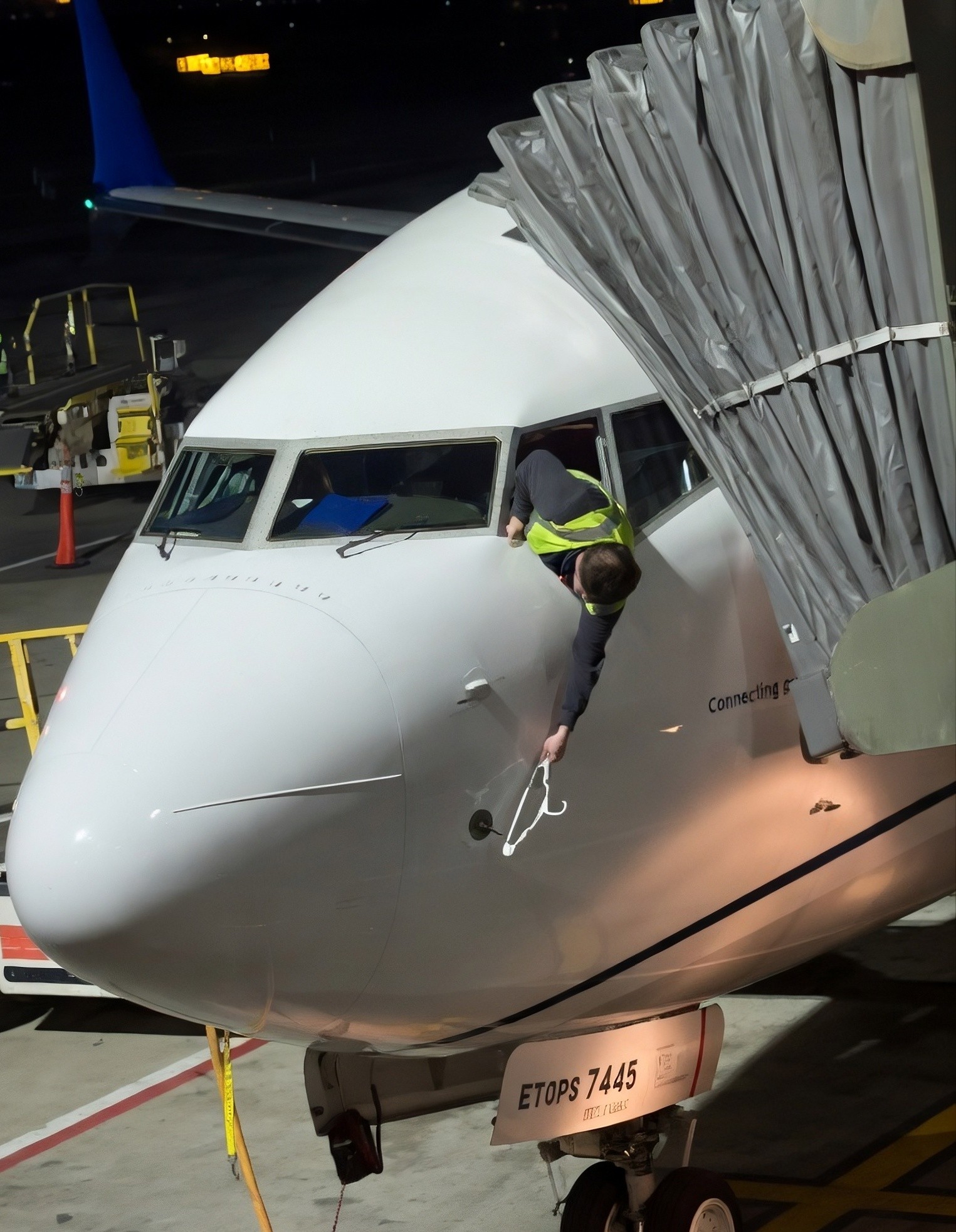
A video captured by passengers at Newark Liberty International Airport has gone viral, showing United Airlines maintenance crews attempting to repair a Boeing 737 using what appears to be a common household coat hanger. While the scene looked highly unconventional, the incident highlights the thin line between necessary troubleshooting and the importance of public perception in aviation safety.
The Incident: Troubleshooting in Plain Sight
On Wednesday night, United Airlines Flight 1928, bound for Austin, experienced a two-and-a-half-hour delay. The delay was captured on video as maintenance workers in high-visibility jackets leaned out of an open cockpit window. Using a long, thin object—resembling a wire coat hanger—they were seen nudging a small, paddle-shaped component on the aircraft’s nose.
The footage shows a coordinated effort: one technician leaned out of the window to manipulate the component, while another utilized a service platform at the adjacent window to coordinate the movement with someone inside the cockpit.
What was being repaired?
Based on the visual evidence, the crew was likely addressing the Angle of Attack (AoA) vane. This critical sensor measures the angle between the aircraft’s wing and the oncoming airflow, providing the flight computer with essential data to prevent aerodynamic stalls.
In many troubleshooting scenarios, if a sensor is suspected of sticking, being contaminated, or providing erratic readings, technicians may attempt to manually move the vane to see if the cockpit indicators respond. This allows them to determine if the issue is mechanical (a stuck vane) or electronic (a faulty sensor).
The Shadow of the Boeing 737 MAX
The optics of this repair are particularly sensitive due to the history of the Boeing 737 MAX. The aircraft was grounded globally following two fatal crashes caused by faulty Angle of Attack sensors. In those instances, the MCAS (Maneuvering Characteristics Augmentation System) relied on data from a single sensor; if that sensor provided a false reading, the system would repeatedly force the plane’s nose downward.
Since those accidents, aviation regulations and aircraft designs have changed significantly:
– Redundancy: Modern systems now compare data from both AoA sensors.
– Discrepancy Alerts: If the two sensors disagree by 5.5 degrees or more, the system is designed not to activate and will instead alert the pilots.
While the sensor in question is much safer today than it was eight years ago, any visual involving a “makeshift” tool like a coat hanger immediately triggers anxiety regarding maintenance standards.
Safety vs. Perception
It is important to note that a manual “nudge” of a sensor is a diagnostic step, not a final repair. Aviation regulations are strict: a sensor cannot be cleared for flight simply because it moved; it must undergo rigorous calibration and testing.
In this specific case, the fact that United Airlines ultimately swapped the aircraft entirely rather than attempting to fly the plane after the “hanger” repair suggests that the safety protocols worked. The airline identified a technical discrepancy and, rather than risking a flight with a questionable sensor, opted to replace the jet.
While the method appeared improvised and unprofessional to onlookers, the decision to swap the aircraft demonstrates that the airline’s safety net—detecting a fault and removing the plane from service—remained intact.
Conclusion
The incident serves as a reminder that while technical troubleshooting can sometimes look unpolished to the public, the ultimate measure of safety is whether an airline chooses to ground a suspicious aircraft rather than fly it.