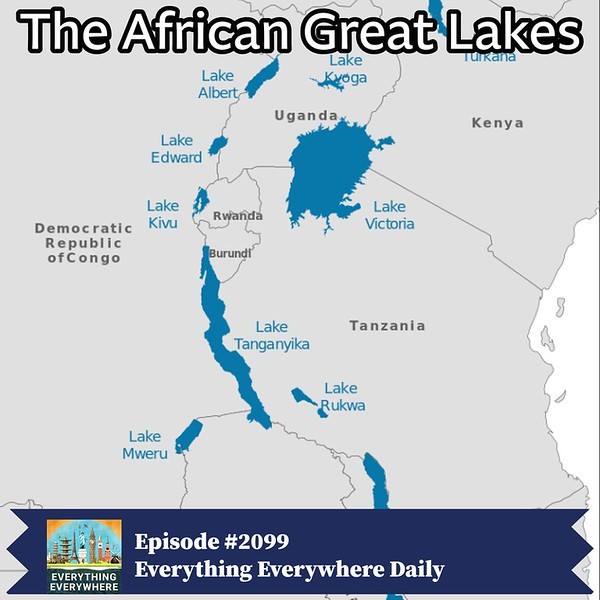
While many think of Africa through its vast savannas or deserts, the continent is defined by an equally massive feature: its freshwater. The African Great Lakes are not merely scenic landmarks; they are a massive, interconnected system of ancient waters that hold roughly 25% of the world’s unfrozen freshwater.
Spanning ten countries across East and Central Africa, these lakes are the result of a continent literally tearing itself apart.
A Geological Masterpiece: Born of the Rift
Unlike the North American Great Lakes, which were carved by retreating glaciers roughly 12,000 years ago, the African Great Lakes are tectonic in origin. They sit along the East African Rift, a massive geological scar where the African continent is slowly splitting.
As the earth’s crust stretches and fractures, it creates deep troughs known as grabens. Over millions of years, these basins filled with water, creating lakes that are characteristically long, narrow, and incredibly deep.
- Lake Tanganyika: The second-deepest lake in the world (1,470 meters). Its depths are so profound that the bottom layers have been isolated from the surface for tens of thousands of years, acting as a time capsule of ancient climate data.
- Lake Victoria: The “exception to the rule.” Unlike the deep rift lakes, Victoria sits in a shallow depression between the two arms of the rift. It is the world’s largest tropical lake and was likely shaped by changing rainfall patterns rather than tectonic fracturing.
- Lake Kivu: A site of both beauty and extreme danger. It contains massive reserves of dissolved methane and CO2. If released suddenly in a “limnic eruption,” it could pose a lethal threat to over two million people living nearby.
Evolutionary Laboratories: The Cichlid Phenomenon
Perhaps the most scientifically significant aspect of these lakes is their biological diversity. They serve as world-class laboratories for studying adaptive radiation —the process by which a single ancestor evolves into many different species to fill various ecological roles.
The stars of this evolutionary show are the cichlid fish.
* In Lake Malawi, between 500 and 1,000 unique cichlid species exist, found nowhere else on Earth.
* In Lake Victoria, hundreds of species emerged from a single ancestor in as little as 15,000 years—one of the fastest instances of vertebrate evolution ever recorded.
These fish have developed specialized behaviors, from “scale-eaters” to parents that protect eggs by carrying them in their mouths. While this diversity fuels a massive global aquarium trade, it also highlights the fragility of these ecosystems. The introduction of the predatory Nile perch into Lake Victoria in the mid-20th century led to one of the greatest ecological disasters in history, driving roughly 200 native species to extinction.
The Human Connection: Life, Economy, and Tension
For the 50 million people living near these shores, the lakes are a lifeline. They are the foundation of regional survival in several key ways:
- Food Security: The lakes provide essential protein. Fisheries like those in Lake Victoria support hundreds of thousands of workers and generate massive export revenues.
- Water Supply: Major cities—including Kampala and Mwanza—rely on these lakes for drinking water, irrigation, and industry.
- Transportation: In regions where roads are scarce, lake ferries serve as vital corridors connecting different nations.
- Tourism: From the clear diving waters of Lake Malawi to the research sites of Jane Goodall in Gombe, the lakes are major economic drivers for tourism.
A Source of Geopolitical Friction
Because these waters are shared by multiple nations, they are also a source of diplomatic tension. The management of the lakes is complicated by:
* Border Disputes: Disagreements over where one country’s waters end and another’s begin.
* Resource Competition: Overfishing and the race to control lucrative stocks.
* Downstream Effects: How water usage in one lake affects the flow of major rivers like the Nile.
* Subsurface Wealth: The discovery of oil in Lake Albert and methane in Lake Kivu has added a layer of economic competition to territorial boundaries.
To manage these vast resources, regional organizations like the Lake Victoria Fisheries Organization must work to coordinate policy, recognizing that no single nation can protect these ancient waters alone.
Conclusion
The African Great Lakes are a rare intersection of deep geological time and urgent modern necessity. They are simultaneously ancient evolutionary engines and the vital, fragile lifelines for tens of millions of people.