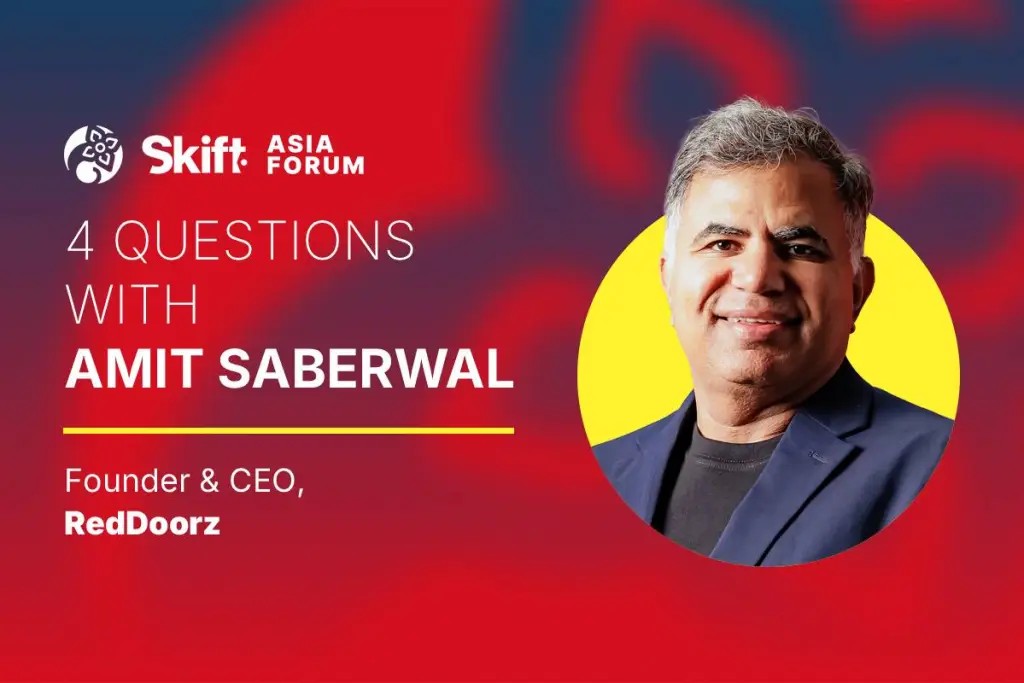
As the travel landscape in Southeast Asia undergoes a profound digital and demographic shift, hospitality leaders are facing a new set of challenges: tighter margins, rising consumer expectations, and a rapid move toward AI-driven booking.
At the upcoming Skift Asia Forum 2026, Amit Saberwal, Founder and CEO of RedDoorz, will share how his platform is navigating these complexities. By leveraging brand segmentation, operational control, and artificial intelligence, RedDoorz is positioning itself to capture the next wave of growth in one of the world’s most dynamic travel hubs.
The Strategy Behind 25% Year-on-Year Growth
Despite global macroeconomic headwinds, RedDoorz has maintained a consistent 25% year-on-year growth rate. This stability is not accidental; it is the result of a deliberate multi-brand strategy designed to capture different segments of the market.
Key drivers of this expansion include:
– Brand Diversification: While the core business focuses on budget stays, premium brands like Sans and Urbanview are seeing explosive growth, increasing by 40-50% annually.
– Operational Control: To ensure consistent service quality—a common pain point in fragmented markets—RedDoorz has expanded its “company-operated” hotel division.
– Aggressive Scaling: This division, which currently manages over 100 hotels, is projected to double in size within the next 12 to 18 months.
Riding the Macroeconomic Wave in Indonesia
Saberwal highlights Indonesia as a blueprint for successful scaling. With a population exceeding 280 million and a massive demographic of young professionals (ages 18–40), the country offers a unique “growth curve.”
The synergy between infrastructure and demographics is critical here. Over the last five years, improved road connectivity and port developments in cities like Bandung, Malang, Surabaya, and Balikpapan have unlocked new business hubs. RedDoorz has successfully aligned its brand evolution with the lifecycle of these young travelers: as their careers and purchasing power grow, RedDoorz introduces new brands to meet their evolving needs, fostering long-term loyalty.
Shifting Traveler Profiles: From Amenities to Experiences
The modern traveler’s priorities have shifted significantly compared to the pre-pandemic era. According to recent trends, several key patterns are emerging:
- Short-Haul & Regional Focus: Due to economic uncertainties, travelers are opting for shorter, 3–4 day regional trips.
- The “Experience” Economy: Travelers are no longer willing to spend their entire budget on luxury accommodations. Instead, they seek reliable, reasonably priced stays that allow them to reallocate funds toward local culture and unique experiences.
- Authenticity Over Amenities: There is a growing preference for centrally located, authentic stays that offer immersion in local life rather than standardized hotel luxury.
- AI-Driven Discovery: The booking journey is becoming hyper-individualized, with 75% of users now utilizing AI-assisted search to plan their trips.
The AI Revolution: Efficiency and Personalization
Perhaps the most significant shift is the transition from “walk-in” bookings to a fully digital ecosystem. With internet penetration in Southeast Asia reaching 75%, the battle for market share is now fought on digital platforms.
For operators, the next phase of growth will depend on operational flexibility. Saberwal notes that AI is no longer just a tool for customer-facing search; it is becoming a vital tool for backend efficiency. RedDoorz is currently deploying AI to:
– Enhance personalized search for guests.
– Monitor operations and quality management in real-time.
– Reduce operating expenses by 20–40%, allowing for higher margins even at a massive scale.
“The upcoming phase of growth will be defined by the supply side’s ability to adapt. Hotel operators must enhance their operational flexibility to align with heightened guest expectations.”
Conclusion
The future of Southeast Asian hospitality lies in the ability to balance digital innovation with physical service quality. By using AI to drive efficiency and multi-brand strategies to capture demographic shifts, operators can turn macroeconomic volatility into a scalable growth opportunity.