
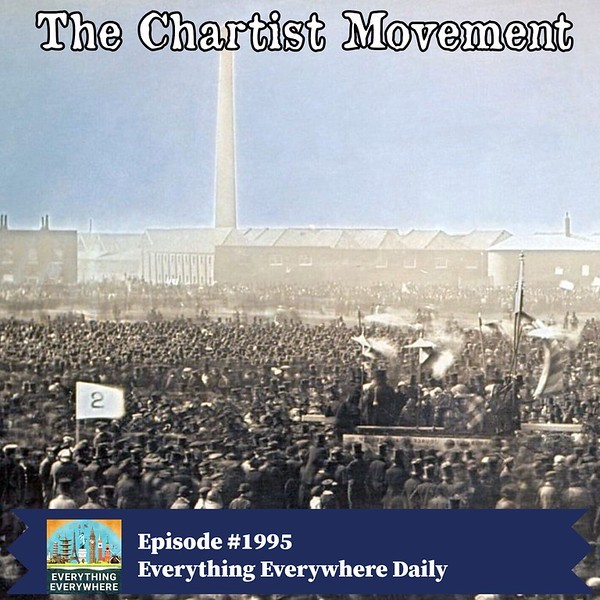
The mid-19th century in Britain witnessed the rise of Chartism, the first large-scale, organized political movement led by the working class. While often described as radical for its time, its core demands – universal suffrage, secret ballots, and parliamentary reform – are now standard features of modern democracies. This episode examines how Chartism emerged from decades of inequality, what it sought to achieve, and why its failure ultimately paved the way for future reforms.
The Roots of Discontent: A System Rigged Against the Poor
For centuries, British politics operated under a system designed to exclude ordinary people. Before the 19th century, voting rights were tied to land ownership and medieval custom rather than democratic principles. The wealthy elite held almost all power, while industrializing cities lacked representation. The Great Reform Act of 1832 attempted to address these imbalances but fell short, leaving most workers disenfranchised.
This disappointment, coupled with economic hardship during the “Hungry Forties” (including unemployment and the harsh Poor Law Amendment Act), fueled widespread discontent. Previous worker movements like the Luddites had been localized, but by the late 1830s, a unified demand for political change began to emerge.
The People’s Charter: Six Demands for a Fair System
In 1838, this demand was formalized into the People’s Charter, a six-point plan for parliamentary reform. Drafted by William Lovett and radical thinkers, the Charter aimed to address the structural barriers that prevented working-class participation in politics. The six demands were:
- Universal Male Suffrage: Every adult man should have the right to vote.
- Secret Ballot: Protect voters from intimidation and bribery.
- Abolition of Property Qualifications for MPs: Allow anyone to stand for Parliament, regardless of wealth.
- Payment for MPs: Enable working-class citizens to serve in Parliament without financial burden.
- Equal Electoral Districts: Ensure each vote carries equal weight.
- Annual Parliamentary Elections: Increase accountability and reduce corruption.
These demands, though considered radical at the time, were fundamentally about fairness and representation – principles now accepted in most democracies.
The Rise and Fall of a Movement
The Chartist Movement gained momentum through mass meetings, petitions, and newspapers like the Northern Star, which reached a vast audience. Three major petitions were presented to Parliament in 1839, 1842, and 1848, each rejected despite containing millions of signatures.
The movement was also plagued by internal divisions between “moral force” Chartists (who advocated for peaceful reform) and “physical force” Chartists (who were willing to use violence). The most violent episode was the 1839 Newport Rising in Wales, where demonstrators clashed with soldiers, resulting in deaths and harsh punishments.
By 1848, the movement had lost steam. Improving economic conditions, leadership infighting, and the rise of trade unions as an alternative focus for workers all contributed to its decline. The final petition of 1848 was found to contain fraudulent signatures, including from Queen Victoria herself, marking a humiliating end to the movement.
A Legacy of Change
Though Chartism ultimately failed to achieve its immediate goals, its impact on British society was profound. Over the following decades, five of the six demands were implemented: property qualifications for MPs were abolished, the secret ballot was introduced, electoral districts were equalized, MPs began receiving payment, and universal male suffrage was eventually achieved.
Chartism normalized the idea of working-class political participation and influenced democratic movements worldwide. Its legacy continues today, as its ideals have become cornerstones of modern democratic systems.
The movement’s story serves as a reminder that even failed uprisings can shape history by forcing societies to confront inequality and paving the way for future reforms.