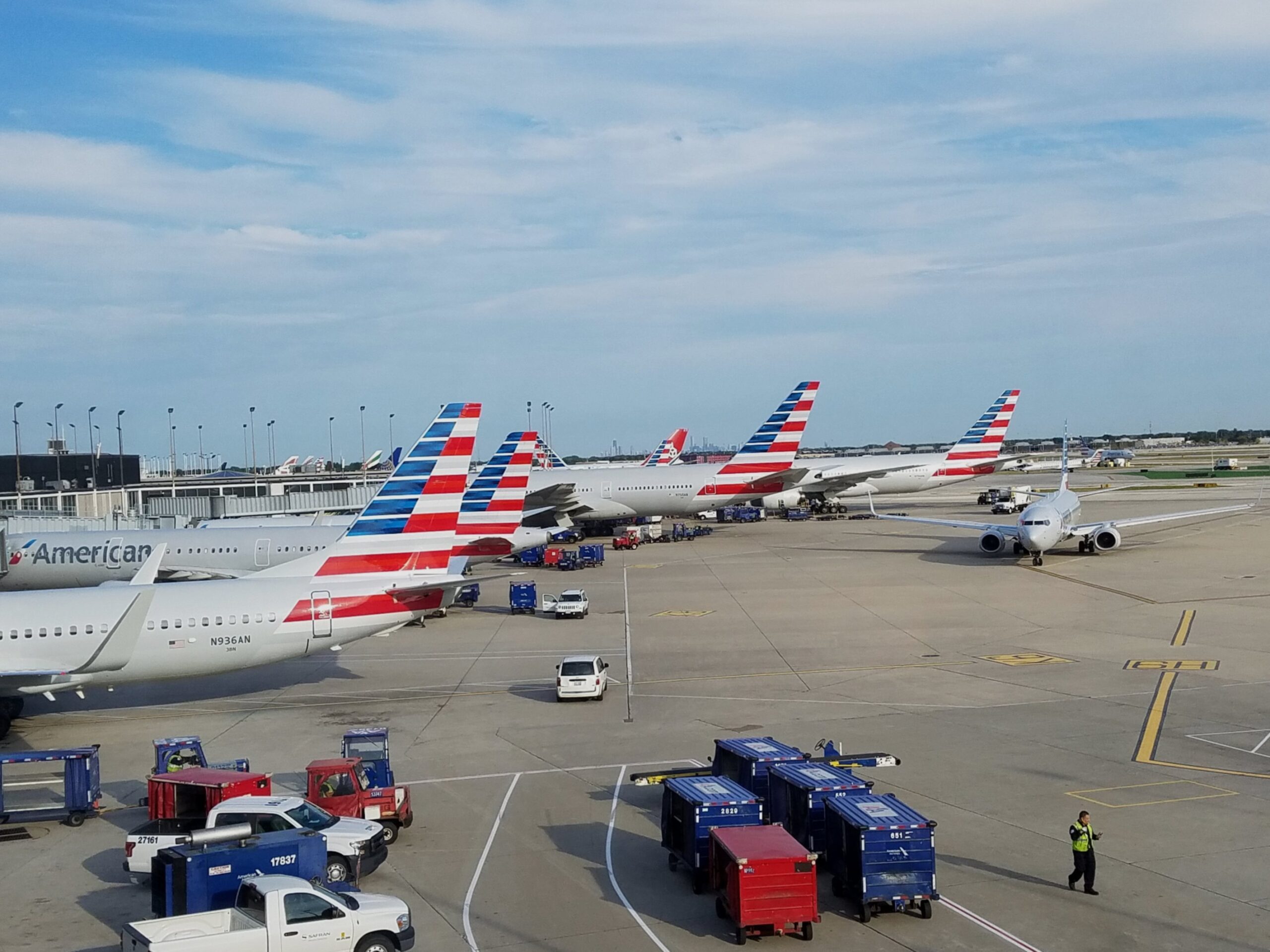
American Airlines (AA) has directly responded to assertions made by United Airlines CEO Scott Kirby regarding alleged financial losses at AA’s Chicago O’Hare hub. Kirby has publicly claimed American loses up to $1 billion annually at O’Hare, positioning it as evidence of AA’s operational inefficiencies and justifying United’s expansion in the market. However, AA’s Chief Financial Officer, Devon May, countered these claims, asserting that O’Hare does contribute positively to the airline’s overall profitability when assessed using standard business decision-making metrics.
The Debate Over Profit Measurement
The core of the dispute lies in how profitability is calculated. Kirby’s figures rely on a fully allocated cost accounting approach, including overhead expenses like corporate headquarters and fixed infrastructure costs. May argues this method is misleading for operational decisions. He explains that AA evaluates hub performance at three levels: direct operating costs, direct costs plus asset ownership (including rent and maintenance), and finally, fully allocated pretax profit.
According to May, O’Hare consistently covers its direct operating and ownership costs – meaning it generates enough revenue to pay for its immediate expenses and asset upkeep. While a fully allocated view might show lower margins due to shared corporate overhead, this isn’t how the airline makes decisions. Allocating overhead arbitrarily doesn’t reflect true profitability drivers. In short, shrinking O’Hare wouldn’t eliminate that overhead; it would simply shift it elsewhere.
Network Effects and Co-Brand Revenue
Beyond basic cost accounting, May highlighted two critical factors often omitted from simplistic profitability analyses: network effects and co-brand credit card revenue. A smaller presence at O’Hare weakens the airline’s network by reducing connection options for passengers in surrounding markets. This diminishes customer loyalty and weakens its broader reach.
Crucially, a reduced footprint in Chicago also negatively impacts American Airlines’ co-branded credit card program, AAdvantage. A strong presence in key markets like Chicago drives card acquisition and spending, boosting revenue beyond ticket sales. This interconnectedness means that cutting back in Chicago could harm the airline’s broader financial health, even if it appears “losing money” on a purely accounting basis.
The Bigger Picture
May is correct that fully allocated accounting profits are a poor guide to operational decisions in capital-intensive network businesses. If O’Hare covers its variable costs, fixed ownership costs, strengthens the network, and supports loyalty revenue, then calling it a “money loser” is inaccurate. However, the CFO did not claim O’Hare is an exceptionally high-performing asset. AA’s resources could be deployed elsewhere with greater returns.
The debate underscores a fundamental challenge in airline finance: determining whether a hub is simply profitable versus whether it’s the best use of capital. O’Hare may contribute positively, but that doesn’t mean it outperforms other potential investments within AA’s network. Ultimately, the real question isn’t just whether O’Hare makes money, but if it makes enough money compared to alternative opportunities.